
India’s influencer marketing industry has crossed a threshold that changes everything. Not a milestone, a structural shift. What was once a line item in a media plan has become core commercial infrastructure, and the money flowing through it tells a story that every brand, creator, and platform strategist needs to understand right now.
The influencer marketing market size in India reached an estimated ₹3,000–3,500 crore in 2025. By 2026, that number is projected to reach ₹4,500–5,000 crore. The sector is scaling at roughly 22% CAGR year over year, and the more telling development is not how much is being spent but how deliberately it is now being allocated.
Table of Contents
ToggleThe Institutionalization of Influence
The informal era is over. Handshake deals and WhatsApp rate cards are giving way to standardized contracts, legal procurement reviews, and performance-linked payment structures. Around 39.3% of brands now route influencer contracts through formal legal review, a practice that was near-zero just two years ago.
The CFO has entered the room. Approximately 14.3% of brands formally tie influencer marketing to revenue targets, while 46.4% link it to performance metrics in at least some campaigns. The era of treating influence as a soft, unaccountable channel is closing. This is now a media investment with a dashboard, a ROAS, and a leadership slide.
Platform-side, enterprise influencer tools are absorbing the operational workflows that once required email chains and spreadsheets. A quarter of brands are already on enterprise influencer platforms; another quarter use agency tech stacks. Discovery, contracting, briefing, approvals, and payment settlement are being systematized at scale, and 61% of brands are actively exploring these tools to bring greater efficiency to their campaigns.
Where the Influencer Marketing Spend in India Actually Goes
The platform distribution of influencer marketing spend in India reveals where brand priorities sit and where they are shifting. Instagram commands 55–60% of total spend, a reflection of its structural advantage as the platform where discovery, engagement, and conversion can happen within a single session. Instagram Reels delivers 4–6% average engagement, the highest commercial format across all platforms, which directly explains its persistent dominance in budget allocation.
YouTube accounts for 23–27% of spend, fulfilling a different role: depth, trust-building, and long-form decision-making content, particularly in finance, technology, and education. LinkedIn’s share has grown to 7–9%, a clear signal that B2B influence is maturing in India and brands are beginning to treat professional thought leadership as a legitimate media investment.
Across sectors, e-commerce leads influencer marketing budgets at 23–25% market share, with projected annual spend reaching ₹1,000–1,200 crore. FMCG follows at 18–20%, with spend of ₹800–1,000 crore annually. BFSI is the fastest-growing sector, with 20–30% year-over-year growth, driven by brands investing in credentialed, compliant creators to rebuild trust in the post-regulatory restructuring environment.
The Bharat Blueprint: Where Engagement Truly Wins
The most important budget reallocation story in India’s creator economy is geographic. Tier 2, 3, and 4 cities now account for 43–48% of all influencer campaigns and they are outperforming metros on every metric that ultimately drives commercial outcomes.
Tier 3/4 creators deliver 4.5–5% engagement versus 3.5–4% in metros, at a dramatically lower cost. Average campaign spend in Tier 3/4 runs ₹30,000–80,000, compared to ₹3.5–4 lakh in metro markets. The cost-per-view efficiency is transformative for performance-driven influencer marketing, and brands that have made the structural commitment to regional Bharat are seeing it in their numbers.
The creator language data reinforces this shift. 68.2% of creators use Hindi as their primary language; 23.9% create in regional languages including Tamil, Telugu, and Kannada. Over 62% of creators report that brands are now requesting significantly more vernacular content and the brief has changed to reflect it.
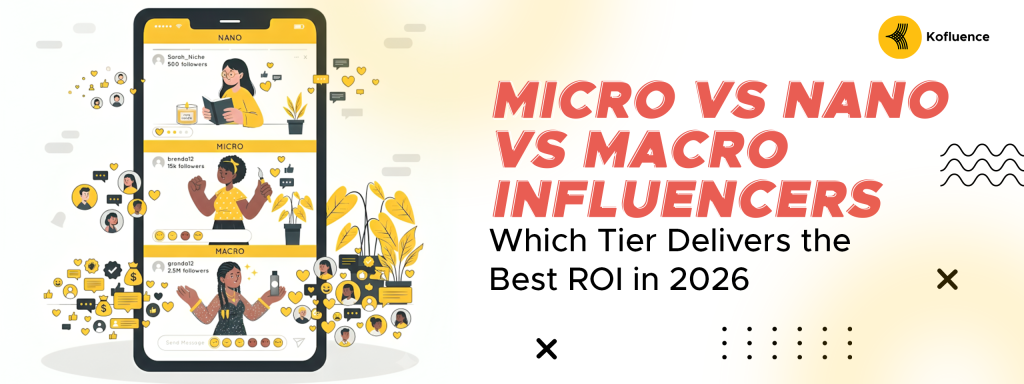
Micro-influencers in the 10,000–100,000 follower range remain the most preferred category for regional outreach. 52% of marketers find creators in this tier best suited for hyper-localized campaigns, where trust and cultural resonance consistently outperform scale.
Nano and Micro: The Performance Case for Smaller Creators
The influencer marketing industry’s decade-long chase for celebrity scale is giving way to a more sophisticated understanding of how influence actually converts. 61.1% of India’s active creator base sits in the nano tier (1,000–10,000 followers), the most community-rooted segment, now being deployed at scale for the first time.
The economics are not complicated: a creator with 50,000 highly engaged followers in a Tier 2 city consistently outperforms a celebrity with 5 million generic followers when the campaign objective is purchase intent or community trust. The Nykaa Matte-to-Last launch, which activated 1,000 nano creators through a barter + fixed model, delivered 6% engagement as a percentage of genuine interaction and intent, not passive impressions.
Short-form video is the undisputed engine of this tier. 84.5% of creators identify short-form video (Reels, Shorts) as their highest-monetizing content format. Raw, authentic content is consistently outperforming high-production value; 49.2% of creators confirm their audiences prefer unpolished content. For brands operating in everyday consumer categories, this is a media insight with direct creative and budget implications.
AI, Commerce, and the Technology Shift
Influencer marketing campaigns in India are increasingly powered by AI at every stage of the production pipeline. 59% of creators regularly or sometimes use AI tools in their workflows; 25.5% use them almost daily. The tool has moved from early-adopter signal to operational baseline in under two years.
Content ideation and caption generation lead AI adoption at 64.4%, followed by creative design (31.9%), trend analysis (28.1%), and social media scheduling (25.9%). The efficiency gain is structural: creators who previously produced three pieces of content a week can now produce seven without compromising quality. That compression changes the economics of creator businesses fundamentally.
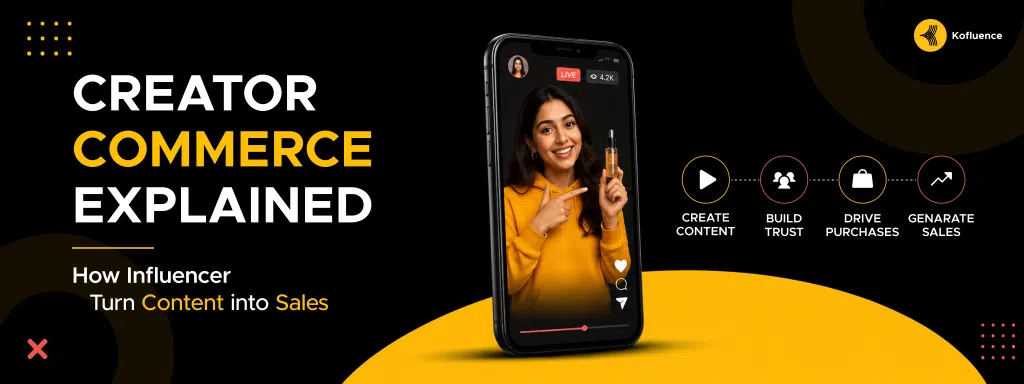
On the commerce side, live selling is collapsing the awareness-to-purchase journey into a single session. Instagram Shops, YouTube Shopping, and creator-affiliate models are engineering native checkout, compressing the time between content and cart. 76.6% of brands have run partnership ads with influencers on Meta or other platforms, with 23.3% doing so regularly across multiple campaigns. The creator is no longer the top of a funnel in live commerce, the creator is the entire funnel.
From Campaigns to Always-On Ecosystems
The one-off campaign model is contracting. Brands are building always-on creator ecosystems over campaign spikes and the creator supply side is ahead of the demand side in demanding exactly this. 47.1% of creators strongly prefer long-term ambassador-style partnerships over one-off briefs; 75%+ collectively lean toward sustained relationships.
The brand-side data reflects a matching shift. 48.3% of brand professionals agree that long-term creator partnerships deliver better ROI than one-off campaigns, with virtually no respondents disagreeing. Performance-linked structures are growing alongside this: 43.3% of brand contracts now include 1–25% performance linkage, with the proportion of fully flat-fee contracts declining year over year.
The influencer marketing ROI conversation has matured accordingly. 33.5% of brands always report influencer performance alongside paid media in leadership reviews; 23.8% do so in separate reports. Influence has earned its board slide and the brands building systematic creator ecosystems are compounding that advantage with every campaign cycle.
What This Means for the Decade Ahead
India’s influencer marketing industry is not catching up to global benchmarks; in several dimensions, it is setting them. The depth of vernacular creator ecosystems, the scale of micro-influencer commerce activation, and the rate of AI tool adoption among working creators collectively represent a market architecture that global brands operating in India need to understand from first principles.
The creator economy’s 4.4+ million active creators, growing at 22% CAGR, represent an infrastructure, not just an audience. The brands building long-term partnerships, integrating creator content into performance media, and treating influencer marketing investment with the same rigor as any other commercial channel are positioning themselves to compound advantage as this market continues to formalize.
The ₹5,000 crore engine is running. The question for every brand is whether they are building a system inside it or still buying individual placements.
Explore how Kofluence’s data-led approach to creator partnerships can help your brand build this kind of systematic influence engine at kofluence.com.
India’s influencer marketing industry will look very different in 2030 than it does today. The brands that institutionalize now will be the ones who design that future.