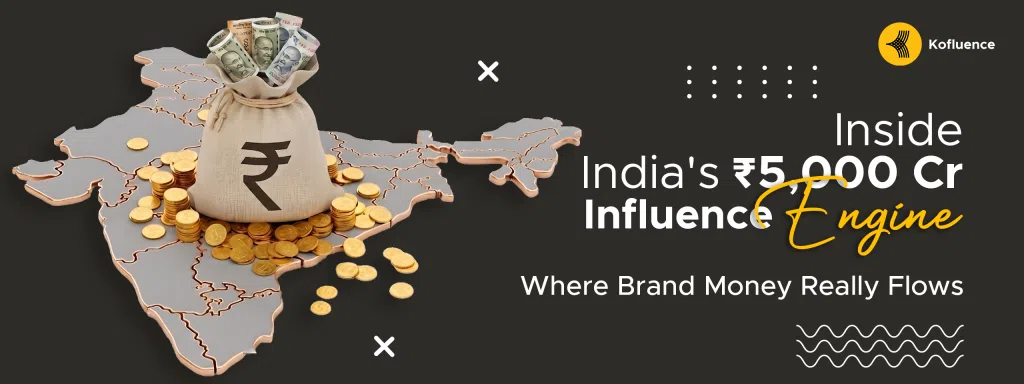


India’s influencer marketing sector crossed INR 3,000-3,500 crore in 2025, sustaining a 22% CAGR and tracking toward INR 4,500-5,000 crore by 2027. At that scale, regulation is not an obstacle to growth. It is the infrastructure that makes institutional-grade growth possible.
Four active regulatory frameworks, plus an emerging legislative signal, are collectively doing something the industry could not do for itself: creating the conditions for trust to be commercially investable.
This blog maps what each regulatory body is building, what it specifically delivers to brands and creators, and where meaningful gaps remain.
SEBI: Credential Infrastructure for the Most High-Stakes Content Category
SEBI’s intervention in financial creator content is the most systematic regulatory programme currently operating in the Indian creator economy.
Enforcement Timeline
- June 2023: Circular restricting SEBI-regulated entities from associating with unregistered financial influencers
- August 2024: Takedown of 15,000+ websites and 8,890 social media accounts
- October 2024: Directive requiring regulated entities to sever all ties with unregistered finfluencers within three months
- March 2025: 70,000+ misleading financial posts removed
The CFA’s Clicks and Credibility Report (March 2025), which polled 1,600 investors and audited 51 active finfluencers, found that:
- Only 2% held SEBI registration
- 33% were making specific stock recommendations
- 63% were failing to disclose sponsorships adequately
SEBI has created a verifiable credential infrastructure for financial creators. Creators offering investment advice must register as SEBI-registered Investment Advisers (RIA) or Research Analysts (RA), while financial education creators remain outside mandatory registration.
For BFSI brands, this creates a due diligence mechanism that previously did not exist. The Decoding Influence 2026 report projects BFSI influencer spend growing at 20-30% YoY, driven by compliant and credentialed creators.
Finance & Crypto now command the highest average CPV (INR 90-150 per view), reflecting the premium attached to compliance-verified creators.
ASCI: Disclosure Standards That Make Creative Investment Safer
ASCI’s influencer disclosure guidelines have existed since 2021, but 2025 enforcement data shows how significant the compliance gap still is.
An ASCI 2025 study of India’s top 100 digital creators found:
- 69% non-disclosure violations
- Only 29% adequate disclosures
Creator Awareness Data
| Awareness Level | Share of Creators |
|---|---|
| Fully aware and consistently compliant | 39.7% |
| Not aware of ASCI guidelines at all | 22.1% |
| Aware rules exist, not fully compliant | 20.8% |
| Heard of guidelines, cannot describe requirements | 17.3% |
ASCI’s current standards require disclosures at the beginning of content, repeated disclosures during live streams, and verbal disclosures in YouTube videos.
ASCI has effectively created a defined standard of care for influencer advertising. This reduces ambiguity for both creators and brands while improving enterprise confidence in influencer-led campaigns.
The report also found that 45.4% of creators have declined brand deals specifically because of regulatory or compliance concerns, indicating rising professional awareness.
Section 194R: The Tax Framework That Is Professionalising the Creator Base
Section 194R changed the tax treatment of non-cash creator benefits. Any product, hospitality, travel experience, or other benefit above INR 20,000 annually is now subject to 10% TDS deduction.
Brands must:
- Document fair market value (FMV)
- Deduct TDS
- Issue Form 16A
Section 194R is functioning as a professionalisation accelerant for India’s creator economy by pushing creators into formal business and tax systems.
Nano creators receiving gifted products above threshold levels now increasingly require:
- GST registration
- Formal invoicing systems
- Tax filing infrastructure
- Business banking
The report notes that 15.2% of creators have now registered as business entities or GST individuals — a figure expected to rise significantly.
The DPDP Act: Privacy Compliance as Campaign Architecture
The Digital Personal Data Protection (DPDP) Act governs how personal data moves between brands, creators, agencies, and audiences.
Under DPDP, all entities collecting or processing Indian user data become Data Fiduciaries with obligations including:
- Explicit consent
- Purpose limitation
- Data minimisation
- Breach notification
Penalties can reach INR 250 crore for significant violations.
Creator Privacy Practice Data
| Privacy Practice | Share of Creators |
|---|---|
| Adjusted privacy settings | 38% |
| Actively limit personal information | 22% |
| Avoid sharing sensitive content | 19% |
| No security measures taken | 10% |
DPDP has introduced the first formal legal architecture governing audience data flows inside influencer marketing ecosystems.
This framework benefits brands through documented compliance systems while simultaneously protecting creators from unauthorised audience data exploitation.
The National Creator Economy Bill: The Structural Signal for 2026 and Beyond
The proposed National Creator Economy Bill would formally recognise digital creators as professionals under Indian law.
Proposed Provisions
- Mandatory MIB registration for high-earning creators
- AI-generated content disclosure rules
- Creator Welfare Fund
- Standardised commercial contracts
| Creator Tier | MIB Registration | GST Compliance | Welfare Fund | Standardised Contracts |
|---|---|---|---|---|
| Nano (1K-10K) | Not required | Below threshold | Not eligible | Not mandated |
| Micro (10K-100K) | Threshold zone | GST kicks in | On registration | On registration |
| Macro (100K-500K) | Mandatory | Full compliance | Full access | Mandatory |
| Mega/Celebrity (500K+) | Mandatory | Full compliance | Full access | Mandatory |
The National Creator Economy Bill remains proposed and anticipated. Its final form, implementation timeline, and legislative passage are not yet confirmed.
The Unfinished Work: Platform Accountability and Synthetic Content
Significant gaps remain in India’s creator economy regulation landscape.
Current frameworks primarily regulate creators and brands, while platforms distributing and monetising content face limited direct accountability.
AI-generated content governance also remains underdeveloped:
- No explicit ASCI AI content rules
- No voice cloning liability framework
- Limited deepfake enforcement mechanisms
- Weak AI labelling enforcement
These gaps are expected to narrow over time as enforcement frameworks mature.
The Aggregate Effect: What These Frameworks Build Together
Together, SEBI, ASCI, Section 194R, and DPDP are transforming influencer marketing from an informal creator economy into an institutional commercial ecosystem.
The report highlights that:
- Only 22.7% of brands route all influencer contracts through formal procurement or legal review
- 47.8% still manage contracts case-by-case without standardisation
Minimum Compliance Requirements in 2026 Creator Contracts
| Contract Element | Regulatory Basis | Minimum Requirement |
|---|---|---|
| Disclosure obligations | ASCI | Platform-specific, format-specific, beginning-of-content placement |
| Financial content restrictions | SEBI | RIA/RA registration verification where financial advice content is involved |
| TDS documentation | Section 194R | FMV of non-cash benefits, Form 16A process, INR 20,000 threshold tracking |
| Data handling terms | DPDP | Purpose limitation, consent framework, retention period, breach notification |
| Pre-publish approval workflow | ASCI + SEBI | Brand-side compliance review before any content goes live |
Compliance investment in India’s influencer economy is no longer just legal protection. It is a market access strategy.
Enterprise brands increasingly require creators to operate with formal compliance, documented disclosures, tax infrastructure, and contractual rigour before campaigns are approved at scale.
Conclusion
India’s influencer marketing ecosystem is entering its institutional phase. Regulation is no longer operating as an external pressure mechanism. It is becoming the operating system through which scalable creator commerce functions.
SEBI creates credential trust. ASCI standardises disclosure behaviour. Section 194R formalises creator economics. DPDP governs audience data relationships. The proposed National Creator Economy Bill signals that the creator economy is increasingly being treated as industrial infrastructure rather than informal internet activity.
The creators and brands building compliance-first systems today are positioning themselves for long-term market access, enterprise partnerships, and regulatory resilience in the next phase of India’s creator economy.