
India’s influencer marketing industry is tracking toward INR 3,375 crore in 2026 at an 22% CAGR (YoY), while the global market sits near $32.6 billion. That scale changes the questions planners ask, and reach alone stopped settling budget debates some time ago. The influencer marketing trends defining 2026 centre on efficiency, trust, regional depth, and measurement.
Table of Contents
ToggleKey Findings
- India’s influencer marketing industry is tracking toward INR 3,375 crore in 2026 at an 22% CAGR (YoY), with the global market near $32.6 billion.
- Over 62% of creators now receive more region-specific briefs, making vernacular demand a planning input.
- Around 15% of India’s active creators have registered as GST entities or formal businesses.
- Short-form video is the commercial engine, cited by 84.5% of creators as their highest-monetising format.
- Tier 3 and Tier 4 creators deliver 4.5–5.5% engagement against 3–4% in metros, at far lower cost.
- Kofluence’s 750K+ creator network spans 30 languages, giving brands a discovery layer no single roster can match.
Why 2026 Is a Defining Year for Influencer Marketing
The market crossed a structural threshold this cycle. Spend that once moved through one-off collaborations now flows through repeatable systems built around performance accountability, formal contracts, and commercial outcomes. India’s creator economy growth is being driven by a deep, multilingual base of regional creators operating as businesses, while brands build always-on programmes and platforms standardise discovery and reporting. Read together, the social media advertising trends India is producing point to one outcome: influence is becoming infrastructure, and planners who build around systems will compound their returns.
The 15 trends below fall into three clusters: the creator landscape, technology and commerce, and market structure and trust.
The 15 Influencer Marketing Trends You Need to Know
1. Micro and Nano Creators Become the Default Choice
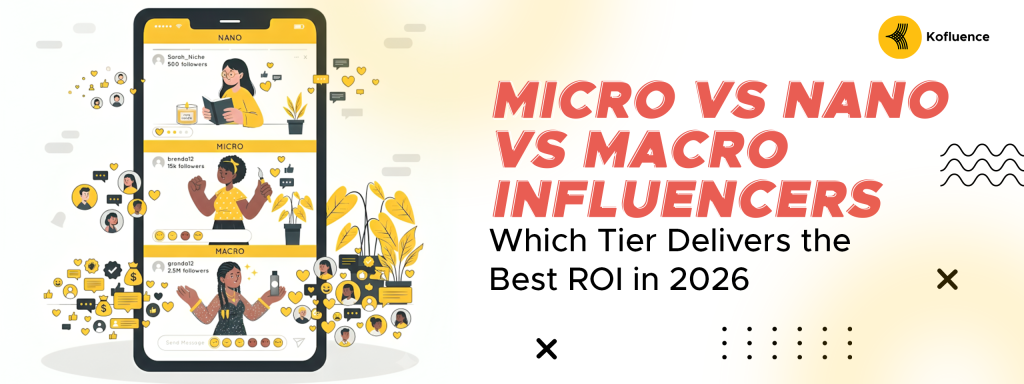
Micro (10K–100K) and nano (1K–10K) creators are now the primary unit of most performance-led campaigns. The nano influencer engagement rate sits in the 5–7% range, well above mega accounts, and audiences treat these recommendations as peer advice. In India this fits how trust travels in smaller communities, where a locally known creator outweighs a distant celebrity, as health brand Revital H has shown with relatable, everyday creators.
Tip: Build around clusters of 15–25 micro and nano creators in your target geographies before committing to one large name.
Influencer Tier Comparison
| Tier | Follower Range | Indicative Engagement | Indicative Cost (per deliverable) | Best Use Case |
|---|---|---|---|---|
| Nano | 1K–10K | 5–7% | ₹2K–₹15K | Hyperlocal trust, reviews, seeding |
| Micro | 10K–100K | 3.5–5% | ₹15K–₹1L | Niche communities, UGC at scale |
| Macro | 100K–1M | 1.5–3% | ₹1L–₹8L | Category reach, considered purchases |
| Mega / Celebrity | 1M+ | 1–2% | ₹8L+ | Mass awareness, launches, IP |
*Ranges are indicative benchmarks and vary by category, platform, and deliverable.
2. Short-Form Video Holds Its Lead
Short-form vertical video remains the highest-monetising and most discoverable format, named top-earning by 84.5% of creators in 2026. The global reels vs TikTok influencer performance comparison shapes format strategy worldwide, and in India that energy runs through Instagram Reels, YouTube Shorts, and Moj. The format carries regional tone well, which makes it the natural home for vernacular campaigns.
Tip: Brief creators for a series of three to five short pieces rather than a single hero video.
3. Raw, Authentic UGC Outperforms Polished Production
Lightly produced, user-generated content wins attention and conversion over high-gloss brand films, with close to half of creators reporting audiences prefer it. A strong UGC content strategy treats the creator’s own voice and setting as the asset. In India, lo-fi authenticity reads as credibility, especially across Tier 2 and Tier 3 markets where polished content feels distant.
Tip: Hand creators the product and the proposition, then give them room to express it in their own format.
4. Vernacular and Regional-Language Content Goes Mainstream
Local-language content has moved from add-on to core requirement, with over 62% of creators receiving more vernacular briefs. Content in Hindi, Tamil, Telugu, Bengali, and other languages consistently lifts response in its home market. This places Bharat creator marketing at the centre of national planning, with brands commissioning in-language content from day one.
Tip: Map your top three growth markets and commission native-language creators for each, rather than dubbing metro content.
5. Long-Term Partnerships Replace One-Off Deals
Brands are shifting from transactional deals to sustained relationships measured over months and years. This brand-creator collaboration 2026 model builds stronger trust, because creators who understand a product represent it more convincingly, and it supports retainer-based income that improves output. In India this maps onto the rise of the brand ambassador programme, where a small roster carries a brand through a full year of moments, from Diwali to launches.
Tip: Convert your three best-performing creators from each campaign into annual partners with defined monthly deliverables.
6. AI Becomes Standard Workflow Infrastructure
AI is now embedded in everyday workflows, with 59% of creators using it regularly and content ideation leading adoption at 64.4%. Brands apply it to creative generation, performance reporting, and campaign management. In India, AI widens output capacity across every tier, letting a single creator sustain the cadence that always-on partnerships demand while keeping voice and judgement their own.
Tip: Let creators use AI for drafting and scheduling, while keeping final creative and tone in their hands.
7. Creator-Led Social Commerce Collapses the Path to Purchase
Shopping is moving inside content, with discovery and checkout on the same surface. Creator-led social commerce shortens the distance between recommendation and transaction through shoppable formats, affiliate models, and live selling, making content measurable against revenue. In India, live commerce is taking a local shape on Meesho Live and JioMart, where value-led, vernacular hosting suits price-conscious shoppers.
Tip: Pilot one live commerce session a month with a mid-tier creator before scaling shoppable formats.
8. Performance-Based Pay Models Gain Ground
Compensation is increasingly tied to outcomes such as clicks, installs, and sales rather than flat fees, which aligns creator incentives with brand goals and makes spend defensible. In India, gaming and fintech lead this shift: gaming brand RummyCircle has run creator activations where payout scales with measurable installs and sign-ups.
Tip: Structure deals as a base fee plus a performance bonus tied to one trackable action, agreed before launch.
9. Measurement and Attribution Mature
Campaign measurement is standardising, with a third of creators now tracking conversion metrics consistently. Strong influencer campaign measurement connects each creator and format to its contribution, sharpening the next plan. In India, the maturing digital influencer campaign ROI conversation is pushing brands to share first-party data with partners, even as data-sharing friction remains a known gap.
Tip: Issue unique tracking links or discount codes per creator so every deliverable maps cleanly to response.
10. Fraud Detection and Verification Become Non-Negotiable
Brands are building authenticity checks into selection to filter inflated followings and bot engagement, which underpins the wider move toward influencer authenticity and trust as a measurable asset. In India, a reliable influencer marketing platform brands can trust screens creators at scale, which is hard to do manually across hundreds of profiles.
Tip: Audit engagement quality and audience authenticity before signing any creator above the micro tier.
11. Regional Bharat Leads, Not Follows
Tier 2, Tier 3, and Tier 4 markets are driving growth and delivering the strongest engagement efficiency, returning 4.5–5.5% against 3–4% in metros at lower cost.
12. Creator Economy Formalisation Accelerates
Creators are registering as formal businesses and obtaining GST numbers, with around 15% already doing so and the figure climbing as norms tighten.
13. Compliance Becomes Table Stakes
Disclosure, data protection, and category-specific regulation are now built into how campaigns are structured.
14. Always-On Creator Ecosystems Replace Campaign Bursts
Brands are building standing creator programmes that run continuously, maintaining presence and sharpening learning between campaigns.
15. Budget Logic Reorganises Around Efficiency
Influencer marketing budget allocation is being rebuilt around where each rupee delivers the most meaningful engagement.
Conclusion
The through-line across all 15 trends is a market that runs on systems for discovery, measurement, commerce, compliance, and trust. India’s creator economy has entered its institutional phase, and the brands building compliance-first, regionally deep, efficiency-led programmes are positioning themselves for the next three years of growth.
In 2026, engagement quality, regional relevance, and measurable outcomes decide which campaigns compound. The planners who treat creator engagement as a budget discipline will set the pace for the rest of the market.
Download the Kofluence Influencer Benchmarking Report 2025–26 (Decoding Influence) for the full benchmark data, regional engagement spreads, and creator trends behind these shifts.
Want to put these trends to work? Explore the Kofluence influencer marketing platform to build creator campaigns across India’s 750K+ creator network.
FAQs
1. What are the top influencer marketing trends in 2026?
Micro and nano creators, short-form video, raw UGC, vernacular content, long-term partnerships, AI-powered workflows, creator-led social commerce, performance-based pay, stronger measurement, and the leadership of regional Bharat markets.
2. Why are micro-influencers more effective than mega-influencers in 2026?
They deliver higher engagement, often 5–7% at the nano level, because audiences treat their recommendations as peer advice, and they cost a fraction of mega accounts.
3. How is AI changing influencer marketing?
It is now standard workflow infrastructure, used by 59% of creators for ideation, captions, scheduling, and trend analysis, while creative judgement stays with the creator and brands use it for generation and reporting.
4. What is the size of the influencer marketing industry in India in 2026?
India is tracking toward INR 3,375 crore in 2026 at a 22% CAGR (YoY), against a global market of roughly $32.6 billion.
5. What is social commerce in influencer marketing?
It places discovery and purchase inside content through shoppable posts, affiliate links, and live selling, taking shape in India on platforms like Meesho Live and JioMart.
6. What is performance-based influencer marketing?
A model where creator payment is tied to measurable outcomes such as clicks, installs, or sales, usually as a base fee plus a performance component.
7. What ASCI rules apply to influencer marketing in India?
ASCI requires clear disclosure of paid partnerships at the start of content, repeated disclosures during live streams, and verbal disclosures in videos.
8. What platforms are best for influencer marketing in 2026?
Instagram Reels and YouTube Shorts lead for short-form, Moj serves regional audiences, and Meesho Live and JioMart are growing for live and social commerce. Platform choice should follow audience behaviour in your target market.
9. What is vernacular influencer marketing?
It uses regional-language creators and content to reach audiences in their own language, and with over 62% of creators receiving more vernacular briefs, it has become a measurable driver of engagement across Tier 2, Tier 3, and Tier 4 India.
10. How do you measure influencer marketing ROI in 2026?
By connecting each creator and format to a trackable outcome using unique links or codes, then comparing cost-per-engagement and conversion across the roster, with first-party data sharing making attribution reliable.