
A festival with a fixed deadline needs an operating plan. A Ganesh Chaturthi Influencer Marketing Campaign has roughly ten days to deliver, and every decision that determines the outcome gets made weeks before Sthapana. Creator contracts close six to eight weeks ahead of peak. Rate cards move 15% to 30% once the festive window opens. Brands that begin planning in the same month as the festival pay inflated rates and lose the creators who actually convert.
Most content on this topic is a list of campaign ideas. Ideas are the easy part. This is the plan a brand team or agency can run from, built around a three-phase framework with dates, a creator selection process, regional casting guidance, compliance requirements and a measurement structure.
Ganesh Chaturthi falls on Monday 14 September 2026. The Chaturthi tithi runs from 07:06 on 14 September to 07:44 on 15 September, with the sthapana muhurat between 11:02 and 13:31. Anant Chaturdashi and the main visarjan fall on Friday 25 September 2026. Households immersing on the first, third, fifth or seventh day will finish earlier. Work backwards from those dates, and check your city panchang, since tithi-based dates shift by a day in some regions.
Table of Contents
ToggleKey Findings
- Creators now take 12% to 20% of festive digital ad spend, up from under 5% when this sat as a PR add-on. Digital itself accounts for 40% to 65% of total festive budgets by category.
- Qoruz projects festive creator spend in India at ₹900 crore for 2026, up 29% from around ₹700 crore, with an estimated 7,200 brands running creator activity against 6,000 in 2025 and 4,500 in 2023. Spend has grown from ₹350 crore in 2023, a CAGR of roughly 37%.
- Ganesh Chaturthi accounts for 11% of festive creator collaborations, behind Diwali at 49% and the Navratri, Durga Puja and Dussehra cluster at 31% (Qoruz). It is the first major creator window of the season.
- Nano and micro creators accounted for 75% of festive creator participation last season, mega creators and celebrities for 5% (Qoruz). Kofluence data puts micro creator engagement at 3.5% to 8% against 1.2% to 2% at the mega tier.
- Native vernacular content delivers up to 30% higher engagement than dubbed pan-India assets. Kofluence’s Decoding Influence 2026 research shows 62% of creators receiving more regional language briefs from brands.
- Regional and Tier 2/3 campaigns now take 25% to 40% of festive media budgets, up from 20% to 25% in the previous cycle.
- Qoruz recorded 28% of tracked product page visits during a recent festive window coming directly from creator links.
- Kofluence’s ARR 2025-26 puts average cost per campaign at ₹35K–₹90K in Tier 3/4 against ₹3.8L–₹4.5L in metros, with engagement of 4.5% to 5.5% against 3% to 4%.
Why Ganesh Chaturthi is a High-Value Opportunity for Brands
Ganesh Chaturthi opens the Indian festive season, and it opens it with unusually specific consumer intent. Over ten days from Sthapana to visarjan, households buy idols, decor, pooja supplies, sweets ingredients, new clothes, appliances and gifts. The festival is culturally recognised as a window for new beginnings, which pulls high-ticket purchases forward into it.
The buying happens inside households rather than individually, and that shapes the content that works. Creator storytelling has moved from the solo creator talking to camera towards family units. Husband and wife duos carry appliance and durables briefs. Mother and daughter pairs work hardest in beauty and apparel. Saas-bahu combinations do the same job across the Hindi belt.
Category spend across the festive season concentrates in consumer durables and electronics at 28% to 32% of creator budgets, fashion and beauty at 20% to 24%, and FMCG at 15% to 18%. Fintech has entered at 8% to 10%, using creators to explain festive gold plans and card reward structures. Quick commerce is the fastest-moving of the newer entrants, with briefs now geo-targeted down to pin code.
Whatever a brand learns during Ganesh Chaturthi festive marketing carries directly into Navratri, Onam, Durga Puja and Diwali. Treating it as the season’s first test rather than a standalone campaign is what makes the investment compound.
Ganesh Chaturthi Across India: State-Wise Audience and Creator Opportunities
Ganeshotsav is often planned as a Mumbai campaign. The festival’s actual footprint is considerably wider, and the creator opportunity looks different in each market.
Maharashtra and Goa carry the highest density of public celebration. Sarvajanik pandals, ten-day household installations, and the pandal-hopping culture around Lalbaugcha Raja and Tulsi Bagh Mandal create a live content calendar that creators are already covering.
Karnataka observes Ganesha Chaturthi alongside Gowri Habba the day before, which adds a distinct women-led gifting and ritual moment ahead of the main festival.
Andhra Pradesh and Telangana celebrate Vinayaka Chavithi, with Hyderabad’s Khairatabad Ganesh drawing enormous footfall and a nine-day arc that ends in immersion at Hussain Sagar.
Gujarat runs strong household and community celebration, often alongside preparations for Navratri, which follows closely.
Pan-India and diaspora audiences engage digitally through devotional content, recipe content and pandal coverage they cannot attend in person.
That spread is the argument for building a Ganesh Chaturthi creator campaign across four or five language markets rather than one.
The 3 Phase Ganesh Chaturthi Campaign Framework
The festival has a fixed structure, and the campaign should follow it. Each phase has a different job, a different content format and a different metric.
| Phase | Timing (2026) | Focus |
|---|---|---|
| Pre-festival build-up | Early August – 13 September | Creator outreach and briefing, anticipation content, prep and unboxing, hamper seeding, regional creator activation |
| Festival live | 14 – 24 September | Real-time content around sthapana and aarti, pandal coverage, Reels and Stories first, UGC amplification, paid boosting of top organic posts |
| Visarjan and post-festival | 25 September onward | Anant Chaturdashi and visarjan coverage, wrap-up storytelling, gratitude and community content, UGC reposting, eco-immersion messaging, performance reporting |
Phase 1: Pre-festival build-up
This phase carries the operational load. Roughly twelve weeks out, lock the objective, the budget, the category focus and the market list. By six to eight weeks out, creator contracts should be closed, because that is where the rate advantage sits before festive inflation begins.
Three to four weeks out, briefs go to creators, scripts get approved and shoot windows get confirmed. Hampers and product seeding should reach creators with enough time for genuine use rather than a rushed unboxing.
One week out, the brand handle gets its festive treatment. Bio link pointed at a festive collection page, hero film pinned, Story Highlights built for recipes, pandal guides and offers. Tracking links and promo codes get tested before anything goes live.
Content in this phase is anticipatory. Home prep, decor planning, shopping guides, idol sourcing, cleaning and setup. Purchase intent builds here, which makes it the highest-converting content window of the three despite the festival not having started.
Qoruz’s data shows roughly half of festive creator campaigns going live two to three weeks before the festival, with the other half landing three to four days out when purchase intent peaks. Splitting the drop rather than firing everything at once is the pattern that performs.
Phase 2: Festival live
Real-time content carries these eleven days. Sthapana on 14 September, daily aarti, Gauri Pujan, pandal visits, cooking, hosting and gifting, through to the eve of visarjan.
Format matters more than volume. Reels and Stories outperform static posts across the live phase because the content is inherently in motion. Interactive mechanics lift the algorithmic signals that decide distribution, so Add Yours stickers, polls, mythology quizzes and aarti countdown timers should be built into the calendar rather than added when engagement dips.
Paid amplification belongs in this phase, applied to organic posts that have already proven themselves. That is a far more efficient use of budget than boosting creatives chosen before launch on instinct.
Phase 3: Visarjan and post-festival
Most brands stop at visarjan on 25 September. The wrap-up phase is where earned value gets consolidated.
Repost the strongest UGC, publish gratitude and community content, run eco-immersion and clean-up messaging where the brand has genuinely participated, and close the loop with creators. Performance reporting happens here, and it feeds directly into the Navratri and Diwali plans that are already being budgeted.
Usage rights determine how much of this phase is available to you, which is why they belong in the original contract.
Regional and language strategy: Beyond Mumbai and Marathi
Regional content drives around 30% higher engagement than English content, according to Qoruz, and Kofluence sees the same gap between native vernacular content and dubbed pan-India assets. Dubbing a single Hindi or English asset into four languages is not a regional strategy. Casting creators who already produce in the language, for audiences in that market, is.
Scale is not the requirement. A Kofluence three-creator activation across MP and Chhattisgarh for an FMCG brand generated 691K views at 100% positive sentiment. Ten Kolkata creators cast by Kofluence for a personal care brand during Durga Puja delivered 1.81 million views at 3.79% engagement with 76% positive sentiment. Tight casting produces those results at small creator counts.
Maharashtra and Goa
Marathi is the working language, and the cultural vocabulary is specific. Sthapana, aarti, modak, Gauri Pujan, Anant Chaturdashi and visarjan are the reference points creators and audiences already use.
Content leans toward household setup, pandal coverage, traditional recipes and the sarvajanik mandal culture. Goa adds Chovoth traditions and a distinct household observance. Creator supply is deepest in this market, which makes selectivity more important rather than less.
Karnataka (Vinayaka Chavithi)
Kannada casting, with Gowri Habba the preceding day as a distinct hook. That day carries women-led ritual and gifting, which opens beauty, apparel, jewellery and home categories ahead of the main festival.
Bengaluru’s urban celebration and the coastal Karnataka observance differ enough that a single creative rarely serves both well.
Andhra Pradesh and Telangana
Telugu casting for Vinayaka Chavithi. Khairatabad Ganesh in Hyderabad is a major footfall and content anchor, and the nine-day arc through immersion at Hussain Sagar gives creators a natural narrative.
Undrallu and kudumulu belong in food content here in the way modak does in Maharashtra, and getting that detail right is a visible authenticity signal.
Gujarat and pan-India / digital-first audiences
Gujarati casting works for household celebration content, with Navratri preparation running in parallel. Ahmedabad and Surat carry strong community observance.
Pan-India and diaspora audiences engage through devotional content, recipe formats and pandal coverage they cannot attend. Hindi and English creators serve this layer, and it is the right place for a festival influencer marketing campaign to run its hero film and celebrity or macro activity, with regional creators carrying conversion beneath it.
Creator Selection Framework
Follower count is the weakest available signal for a devotional festival. A structured selection process filters on five dimensions.
Niche and category fit. A food creator whose audience already trusts them on festive cooking will outperform a larger general lifestyle creator on a modak-adjacent brief. Category affinity beats scale consistently.
Festive content history. Look at what the creator published during the previous Ganesh Chaturthi, Navratri and Diwali. Creators who cover festivals annually have audiences that expect and reward that content. Creators appearing in devotional context for the first time carry more risk.
Brand safety in devotional context. This festival involves religious observance, and the tone requirements are stricter than a standard festive brief. Screen for creators who have handled religious content respectfully, and avoid anyone whose humour or commentary style is likely to read as irreverent in this setting.
Authenticity signals. Automated fraud screening for follower bots, unnatural engagement patterns and comment pods. Festive budgets are compressed, so paying for inflated audiences costs the window as well as the money.
Regional and language fit. Micro-location demography rather than stated location. A creator based in Mumbai with a predominantly North Indian audience serves a different purpose than one with a Maharashtra-concentrated following.
An influencer marketing platform India brands can run discovery through will score most of these before a shortlist goes out, which matters when the contracting window is six weeks wide.
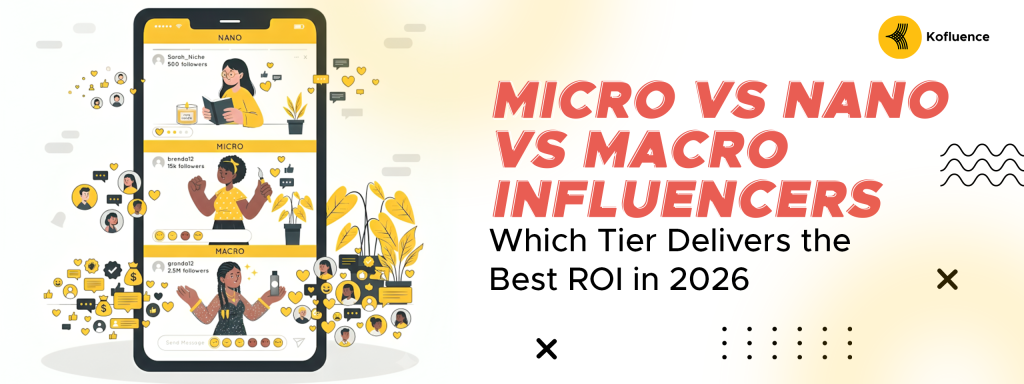
Creator Tier Framework
| Tier | Followers | Role in campaign | Primary formats | Key metrics |
|---|---|---|---|---|
| Nano | 1K – 10K | Hyperlocal UGC, word-of-mouth trust, volume coverage across pin codes | Reels, Stories, community groups | Engagement rate, cost per engagement, UGC volume |
| Micro | 10K – 100K | Niche authority in food, decor, fashion; mid-funnel conversion | Reels, YouTube Shorts | CTR, promo redemptions, saves |
| Macro | 100K – 500K | Regional scale, higher production quality | Long-form YouTube, Reels | Video completion, views, reach |
| Mega / Celebrity | 500K+ | Launch day, pan-India teasers, credibility | Hero films, cross-platform bursts | Impressions, share of voice, brand recall |
Kofluence’s Annual Research Report 2025-26 puts per-collaboration creator earnings in these ranges:
| Tier | YouTube | |
|---|---|---|
| Nano (1K–10K) | ₹1,200 – ₹13,000 | ₹400 – ₹7,000 |
| Micro (10K–100K) | ₹5,000 – ₹2.5L | ₹3,500 – ₹1L |
| Macro (100K–500K) | ₹65,000 – ₹8L | ₹55,000 – ₹7L |
| Mega / Celebrity (500K+) | ₹3.5L – ₹20L | ₹2.5L – ₹20L |
Treat these as planning ranges rather than quotes. Actual rates move with category, deliverable count, exclusivity and usage rights, and they inflate inside the festive window. Two directional notes from the same research: Instagram nano floors have compressed from ₹500 to ₹300 on creator oversupply and barter culture, while YouTube earnings have held or risen across tiers on the strength of native monetisation.
A 75/20/5 split across nano-plus-micro, macro, and mega reflects how festive activations are actually distributed. The engagement gap explains the weighting, and micro and mid-tier creators are currently absorbing 60% to 70% of incremental festive creator budgets.
Campaign and Content Ideas that Actually Work
Pre-Festival Content Ideas
- Home prep and decor series. Creators documenting cleaning, decoration and idol setup, with products entering as part of the process.
- Shopping and gifting guides. Category-specific hauls timed to the week before Sthapana, when purchase intent peaks.
- Eco-friendly idol content. Clay idol sourcing, DIY crafting and sustainability framing, which carries genuine audience interest rather than manufactured concern.
- Hamper seeding and unboxing. Sent early enough for authentic use, not rushed reveals.
- Recipe prep content. Modak, undrallu, puran poli and regional sweets, with ingredients and appliances demonstrated in use.
Festival-Day Content Ideas
- Sthapana and aarti moments. Real-time Stories and Reels from creator households.
- Pandal walkthrough vlogs. Local creators covering major and neighbourhood pandals, with organic placement in what they wear, carry and consume.
- Family-unit storytelling. Husband-wife, mother-daughter and saas-bahu pairings carrying the brief inside genuine household dynamics.
- Festive humour. Creators wrapping the product inside the comedy of a festive household, the last-minute cleaning panic, the relative who arrives early. The audience is already living it.
- Interactive story mechanics. Polls, quizzes, Add Yours prompts and aarti countdowns running daily.
Post-Festival and UGC Ideas
- Photo contests with a tag mechanic. Prabhat Dairy’s #SelfieWithGanpati asked consumers to photograph themselves with home idols, tag the brand and tag three friends, reaching 2.89 million users on Facebook through peer sharing rather than media spend.
- Daily prize structures. Daily hampers sustain participation across all ten days better than a single grand prize.
- UGC repost programmes. Curate the strongest submissions onto the brand grid with permission, which extends creative life at no production cost.
- Visarjan and clean-up documentation. Meaningful only where the brand actually participated.
- Gratitude and community wrap content. Closes the campaign narrative and sets up the next festival.
Compliance and Brand Safety
ASCI’s Guidelines for Influencer Advertising in Digital Media apply to every post where a material connection exists between the brand and the creator. Material connection is broader than payment. It covers free or discounted products, gifts received even unsolicited, contest entries, trips or hotel stays, media barters, awards, and any family or employment relationship. Disclosure is required even when the creator’s opinion is entirely their own and the review is unbiased.
Responsibility sits with both parties. The advertiser must ensure the posted content complies with the ASCI code and can require the creator to edit or delete a post or its disclosure label. The creator is responsible for making the disclosure itself.
Placement. The label must be upfront and prominent. ASCI specifically calls out disclosures that appear only in an About Me or profile page, in bios, at the end of a post or video, or anywhere a consumer has to click “more” to see them. It must not be buried inside a block of hashtags or links. A platform’s own disclosure tool counts as a supplement to the creator’s label, not a replacement for it.
Duration on video. ASCI sets this by video length:
| Video length | Disclosure label must stay for |
|---|---|
| 15 seconds or less | Minimum 3 seconds |
| Longer than 15 seconds, under 2 minutes | One-third of the video’s length |
| 2 minutes or longer | The entire duration of the section mentioning the brand or its features and benefits |
For picture or video posts with no accompanying text, such as Instagram Stories, the label has to be superimposed on the visual and clearly visible. On live streams it is announced at the beginning and the end, and if the recording stays up afterwards, the caption needs a disclosure added. In audio, it is announced at the start, at the end, and before and after every break.
Permitted labels. ASCI lists these, any one or more of which may be used: Advertisement, Ad, Sponsored, Collaboration, Partnership, Employee, Free gift, Affiliate, Instagram’s “Paid Partnership” tag, and YouTube’s “Includes Paid Promotion” tag. The label should be in English or in the language of the advertisement itself. Contrary to a claim that circulates widely online, ASCI does permit Collaboration and Partnership as standalone labels.
Virtual influencers must additionally disclose upfront and prominently that the audience is not interacting with a real human being.
Due diligence. Creators are advised to satisfy themselves that the advertiser can substantiate the claims made in the advertisement.
BFSI, health and nutrition. Addendum 2 requires influencers giving advice or commenting on technical merits in these categories to hold relevant qualifications and to state them upfront. Stock and investment advice requires SEBI registration with the registration number stated alongside name and qualifications. Other financial advice requires an IRDAI licence, CA, CS or similar. Health and nutrition content requires a medical degree or certification as a nurse, nutritionist, dietician, physiotherapist or psychologist as appropriate. Qualifications must be superimposed prominently on visuals or given as the opening remark in video, stated before the body text in blogs, and called out at the start of audio content. Creators without those qualifications can still share generic, non-technical information. A fintech brand running festive gold or credit content through creators needs this checked before briefs go out.
Devotional context adds a second layer that sits outside ASCI. Avoid hard-sell tone during religious moments, avoid using religious symbolism as a decorative product device, and check regional sensitivities before publishing. A creative that works in Mumbai can land badly in Hyderabad. The practical test is whether the content would sit comfortably in a household actually observing the festival.
Budgeting your Ganesh Chaturthi influencer campaign
Creators typically take 12% to 20% of festive digital ad spend, with digital at 40% to 65% of total festive budget depending on category. Those two figures give you a defensible starting envelope.
The cost drivers that move the number:
Tier mix. The 75/20/5 distribution costs very differently from a celebrity-led plan at equivalent reach. Kofluence’s ARR 2025-26 puts the geographic economics in direct terms: average cost per campaign runs ₹35,000 to ₹90,000 in Tier 3/4 markets, ₹1.3L to ₹1.6L in Tier 2, and ₹3.8L to ₹4.5L in metros, while engagement runs 4.5% to 5.5% in Tier 3/4 against 3% to 4% in metros. CPV lands at ₹50 to ₹75 in Tier 3/4 and ₹30 to ₹70 in Tier 2, against ₹80 to ₹200 in metros.
Creator count and market spread. Every additional language market adds casting, briefing, approval and reporting load alongside creator fees.
Content formats. Long-form YouTube and produced films cost materially more than creator-shot Reels. High-ticket categories buy explainers and home-setup demos because the purchase needs confidence, and those cost more to produce.
Usage rights and whitelisting. Now a bigger negotiation than the base fee. Whitelisting adds 60% to 120% over the base rate. Budget for it upfront, because the best-performing creator asset is the one you will want running as paid media through visarjan.
Timing. Rate cards move 15% to 30% inside the festive window and short-form CPMs move 25% to 30%. Late buyers pay the inflation and still lose the high-converting creators.
Paid amplification. Boosting proven organic posts during the live phase, budgeted separately from creator fees.
One caveat on rate inflation. Qoruz’s own read is that festive pressure concentrates on a small group of A-list creators in exceptionally high demand, with most micro, macro and regional creators holding their regular commercial terms. Budget for inflation at the top of the pyramid rather than across the whole plan.
Consolidation reduces cost and turnaround together. Kofluence ran five brands off a single shared creator network across nine campaigns for one FMCG group, cutting turnaround time by 25%. Working with an influencer marketing agency for festive campaigns that already holds contracted regional creator supply removes most of the discovery and negotiation cost from a compressed window.
Measurement and KPI Framework
Separate metrics by funnel stage and judge each phase on what it can actually deliver.
Awareness. Impressions, reach, video views, share of voice. Read during the live phase.
Engagement. Engagement rate, saves, shares, comment sentiment, UGC submissions. Micro creators run 3.5% to 8% engagement against 1.2% to 2% at the mega tier, so set benchmarks by tier rather than campaign-wide.
Traffic and intent. Click-through rate, landing page sessions, add-to-cart, store locator usage. Qoruz recorded 28% of tracked product page visits during a recent festive window coming directly from creator links.
Conversion. Promo code redemptions, attributed sales, cost per acquisition, earned media value.
Set the measurement window honestly. Awareness and engagement read within days. Conversion for considered purchases in durables, auto or BFSI reads over weeks, and cutting the reporting window at visarjan will understate the campaign.
Instrument before launch. Unique tracking links per creator, distinct promo codes, MMP integration where app installs matter. Attribution set up after publish does not exist.
Sample creator brief checklist
A brief that removes ambiguity produces fewer revision rounds, which matters when the shoot-to-publish window is days long.
- Campaign objective and the single primary KPI
- Phase and exact publish date or window
- Platform and format, with runtime and aspect ratio
- Language and regional context notes
- Key message, in priority order, with one non-negotiable
- Product usage requirement and how it should appear
- Mandatory disclosure tag and placement
- Tone guidance for devotional context, with explicit do-nots
- Tracking link and promo code assignment
- Usage rights, whitelisting permission and duration
- Approval process and turnaround deadline
- Reporting requirement and screenshot deadline
AI prompts for campaign planning
Generative tools shorten the planning phase considerably when the prompts carry real constraints. A few worth adapting:
Creator shortlist scoring. “Score these creator profiles against a Ganesh Chaturthi brief for a [category] brand targeting [state], on category affinity, festive content history, audience geography match and devotional-context brand safety. Return a ranked table with a one-line justification per creator.”
Regional script adaptation. “Adapt this 30-second Reel script for a Telugu-speaking Vinayaka Chavithi audience in Hyderabad. Use culturally accurate references rather than translating Maharashtra-specific terms. Flag anything that would not land in this market.”
Phase calendar generation. “Build a dated content calendar for a Ganesh Chaturthi campaign running from 1 August to 30 September 2026, with sthapana on 14 September and visarjan on 25 September. Split into pre-festival, live and post-festival phases with format and KPI per post.”
Brief quality check. “Review this creator brief and list every ambiguity a creator could interpret two ways. Flag missing disclosure, usage rights or tracking instructions.”
Sentiment risk screen. “Review this festive creative concept for devotional-context risk across Maharashtra, Karnataka, Telangana and Gujarat. Flag anything that could read as appropriative or irreverent, and explain why.”
Treat outputs as drafts. Cultural judgement and creator relationships still sit with the team.
Conclusion
A Ganesh Chaturthi Influencer Marketing Campaign succeeds on sequence. Lock the objective and budget twelve weeks out, contract creators before rates inflate, cast for language and household context rather than follower count, run the three phases with different content and different metrics in each, keep disclosure inside the approval workflow, and instrument attribution before the first post publishes.
Brands that want to hire influencers for Ganesh Chaturthi across multiple language markets should begin casting by early August 2026. The festival is the season’s first test, and what works here carries directly into Navratri, Onam and Diwali.
Frequently asked questions
When should planning for a Ganesh Chaturthi influencer marketing campaign begin?
Twelve weeks out for objectives and budget, six to eight weeks out for creator contracts, three to six months out for macro-led campaigns. Rates move 15% to 30% once the festive window opens.
How many creators does a Ganesh Chaturthi campaign need?
Well-cast regional activations have delivered strong results with three to ten creators. Scale the count to the number of language markets rather than to a reach target.
Which creator tier drives conversion?
Micro and nano creators. They run 3.5% to 8% engagement against 1.2% to 2% at the mega tier and account for around 75% of festive activations.
Does regional language content outperform pan-India content?
Regional content drives around 30% higher engagement than English content, according to Qoruz.
What does a creator cost for a Ganesh Chaturthi campaign?
Kofluence’s ARR 2025-26 puts per-collaboration Instagram earnings at ₹1,200 to ₹13,000 for nano creators, ₹5,000 to ₹2.5L for micro, ₹65,000 to ₹8L for macro and ₹3.5L to ₹20L at the mega tier. Rates move with category, usage rights and festive timing.
When is Ganesh Chaturthi 2026?
Monday 14 September 2026, with Anant Chaturdashi and the main visarjan on Friday 25 September 2026.
What are the ASCI disclosure requirements?
Every post with a material connection carries an upfront, prominent label from ASCI’s permitted list. On video, the label stays a minimum of 3 seconds for clips of 15 seconds or less, one-third of the runtime between 15 seconds and 2 minutes, and the full duration of the brand section for videos of 2 minutes or more. Responsibility sits with both the advertiser and the creator.
What share of festive budget should go to creators?
Creators typically take 12% to 20% of festive digital ad spend, with digital at 40% to 65% of total festive budget by category.